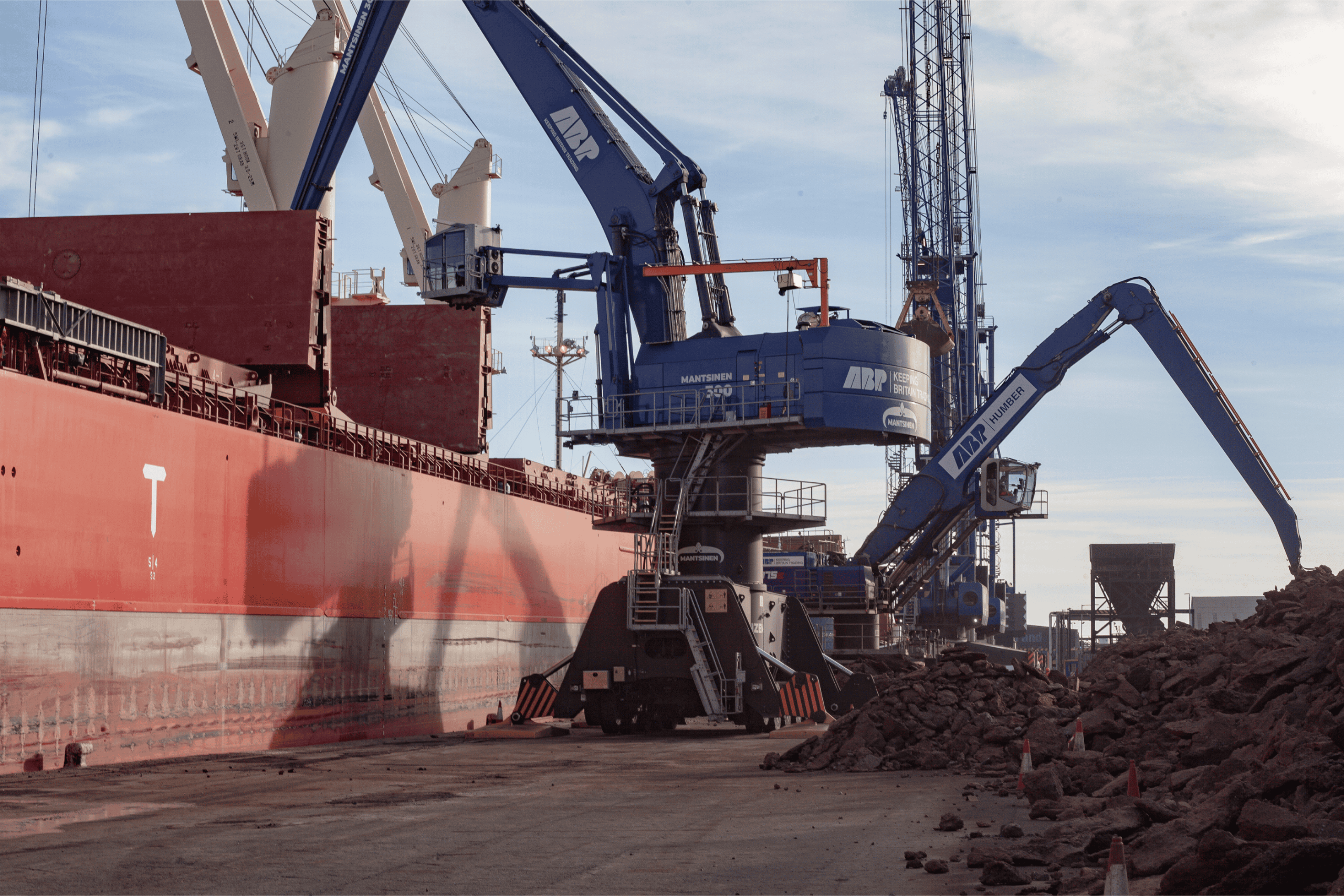

Approximately 70-80% of the scrap metal processed within the UK is exported each year. (1)
Before anyone in Westminster considers implementing regulations, they need to understand what is really at stake.
A brief overview of how the UK scrap metal industry functions
The United Kingdom produces a large amount of scrap metal each year from a variety of sources, including: demolition, decommissioned infrastructure, the dismantling of end-of-life vehicles, and industrial manufacturing waste. This scrap metal is then processed through a series of steps: collection, sorting, grading and preparation for sale to the ultimate buyer. Most of this material does not stay in the UK to be processed into raw materials to be used in domestic industries. Instead, most of it is destined for overseas buyers, primarily in Turkey (rebar), India, Egypt (2) and other countries with electric arc furnace steelmaking capabilities to process the scrap metal as a primary feedstock for the manufacture of new steel.
It was not an accident or a failure of domestic industry that led to the majority of UK generated scrap metal to be sold to international buyers. Rather, it was simply a case of supply and demand functioning exactly as it should. The UK currently generates more scrap metal than it can consume domestically, while global buyers — particularly Turkish mills producing rebar for construction (3) — have both the capacity and appetite to take on that excess.
In summary, the UK scrap metal recycling industry functions as a well-oiled machine with a total value of £9 billion in Gross Value Added (GVA) per annum, employing approximately 15,000 people directly in 300+ operational businesses (4).
The current debate around export restrictions
There are ongoing policy debates surrounding the introduction of export restrictions on the exportation of scrap metal to non-OECD countries. The general argument is that retaining the material in the UK will strengthen the UK steel making industry – particularly as Tata Steel’s Port Talbot facility moves to 100% Electric Arc Furnace operation by 2027 (5), thereby significantly increasing its consumption of scrap feedstock.
The proposed solution seems sensible – keep British scrap in Britain, provide a source of scrap feedstock for domestic steel mills and support UK manufacturers. However, this view of things is greatly oversimplified and the ramifications of such a decision could be serious.
What would actually occur under export restrictions
Market flooding – The UK generates much more scrap metal than there is domestic demand for. Research published in December 2025 (6), commissioned by the British Metals Recycling Association and conducted by Sheffield Hallam University, found that even if all UK steel mills converted to electric arc furnace operation and only consumed scrap metal feedstock, they would only use 67% of the UK’s current annual scrap supply. Therefore, more than one-third of the UK’s scrap supply would have no domestic outlet. Remove the existing export outlets and the remaining surplus would have nowhere to go.
Price collapse – An oversupplied UK domestic market would mean lower prices. Modelling of the effects of export restrictions indicate that ferrous scrap prices may fall by 30-40% (6) if export restrictions are implemented. Aluminium prices may fall by as much as 25% with copper margin compression of 15-18%.
Industry-wide damage – Sheffield Hallam University research (7) estimates that if export restrictions were placed on non-OECD trade, the UK’s economy would suffer a loss of approximately £4.9 billion in GVA and potentially lose 20,000+ jobs. These are not abstract numbers, they represent actual businesses, actual employment opportunities, and actual communities throughout the UK which rely upon a functioning scrap metal recycling sector.
The domestic demand myth
Export restrictions supporters regularly cite electric arc furnace (EAF) steel production growth (8) as proof that domestic demand will consume excess supply. While Port Talbot’s EAF transition is a real demand driver and a vital one for the steel industry, it does not alleviate the overall supply/demand imbalance. According to the Sheffield Hallam report, even the most optimistic domestic demand forecast still indicates that over a third of UK scrap needs to be exported to meet demand. Imposing export restrictions does not generate new domestic demand; rather, it generates oversupply, reduces prices and puts recycling operations at increasing financial risk.
UK metal recycling market contraction
The UK metal recycling industry is facing severe financial pressures at present. Revenue volatility and falling profit margins are being reported by all sectors of the metal recycling industry (both Ferrous & Non-Ferrous) over the last couple of years. Reports from within the industry indicate that total sector revenue has been relatively static for the period 2024–2025; however, there is a growing trend of individual operators experiencing a decline in their profitability, as a result of fluctuating global commodity prices and increasing operational costs.
In this climate, imposing further pressure through export restrictions would exacerbate existing issues and cause long-term structural harm to the UK metal recycling industry.
What international export markets do for UK metal recycling
There are several ways in which international markets benefit the UK metal recycling industry:
Price support: Global buyers’ competition creates competitive prices
Global buyers competing for UK material keeps domestic prices competitive. Without this competition, the pricing power is given to a few domestic buyers.
Volume absorption: Global buyers purchase surplus material not purchased domestically
Export markets purchase surplus material that the UK metal recycling industry is unable to sell domestically. This surplus is purchased, processed, recycled, and sold into the global market. If these buyers did not exist, the surplus would accumulate in UK yards, and many recycling operations would either cease operations altogether or significantly slow down their activities.
Economic viability: Global buyers keep recycling operations viable
Recycling companies require a competitive outlet for their products in order to maintain their economic viability. The margins required to make investments in equipment, hire employees, and maintain business operations require the sale of material at competitive prices. Export markets are a critical element in the ability of recycling businesses to operate profitably.
Sustainable growth: Circular economy at scale
UK scrap exported to Turkey and India does not go away; it is converted back into new steel. Steel is used for rebars in construction projects and structural sections in infrastructure projects. The circular economy does not end at national borders. (9)
Moving towards a more constructive policy debate
A more constructive policy approach would concentrate on providing funding to develop EAF capacity to increase the size of the domestic demand base; assist in developing the necessary processing infrastructure that would enable UK recyclers to compete with global competitors on the basis of product quality; and recognise the recycling industry’s role in helping industrial customers reduce their Scope 3 carbon emissions, which are becoming an increasingly important factor in corporate net zero pledges.
Those UK metal recyclers that have a vertically integrated business model (10) – i.e., those who can manage collection, processing, and exporting material from one operational platform – are ideally placed to lead on this agenda. By integrating the supply chain, they can eliminate transportation stages, reduce associated greenhouse gas emissions and provide lower-cost material to both domestic and international customers.
That is the industry we need to protect.
Bottom line
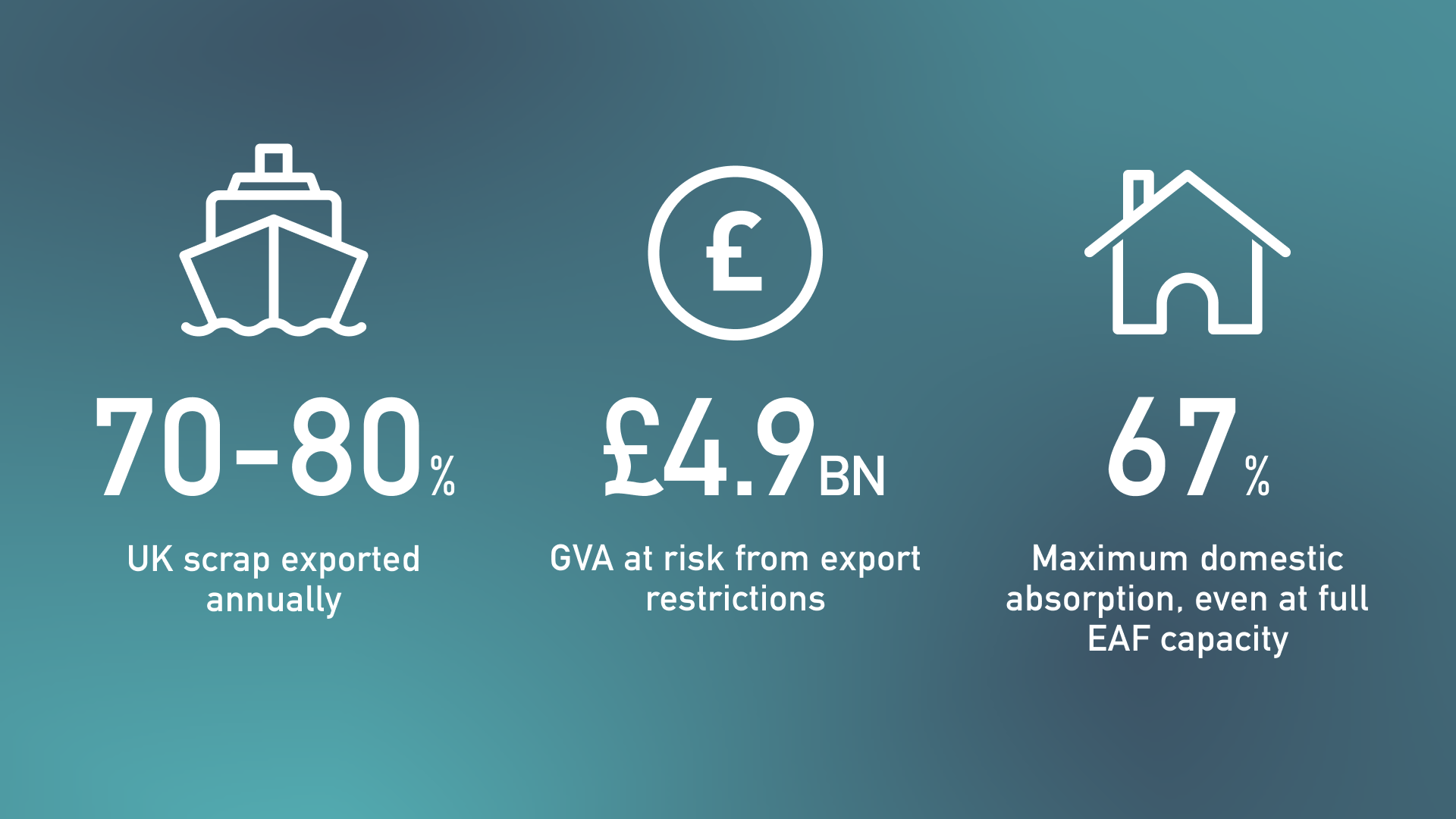
Approximately 70-80% of all scrap produced in the UK is exported. This statistic represents reality, not policy failure.
Research conducted by Sheffield Hallam University, commissioned by the British Metals Recycling Association and released in December 2025, demonstrates that if export restrictions were implemented, the UK economy would lose approximately £4.9 billion in Gross Value Added (GVA) and potentially threaten the livelihoods of more than 20,000 people. Even when operating at maximum EAF capacity, UK-based steel manufacturers would only account for 67% of total UK scrap supply; therefore, an open export market is necessary to facilitate the disposal of the remaining 33%.(11)
Limiting exports does not contribute to the strengthening of the domestic manufacturing sector; it undermines the recycling infrastructure that domestic manufacturing relies upon.
Enicor processes and supplies ferrous and non-ferrous metals to both domestic and international customers from its Immingham and Bourne facilities. Enicor’s vertically integrated model, covering collection, processing and export logistics, provides high-quality materials to global customers. Visit www.enicor.co.uk to learn more.
(1) – The Guardian (2025) Calls for limits on scrap steel exports to boost UK furnaces. The Guardian, 26 August. Available at:
https://www.theguardian.com/business/2025/aug/26/calls-for-limits-on-scrap-steel-exports-to-boost-uk-furnaces.
(2) – IndexBox (2025) *Turkey increases ferrous scrap imports: A key factor in boosting steel production*. IndexBox, 4 February. Available at: https://www.indexbox.io/blog/turkey-enhances-ferrous-scrap-imports-amid-rising-steel-production/
(3) – RecycleMetals (BMRA) (2025) Ferrous scrap exports back to pre-COVID levels. BMRA. Available at:
https://www.recyclemetals.org/newsandarticles/ferrous-scrap-exports-back-to-pre-covid-levels.html.
(4) – RecycleMetals (BMRA) (2025)Potential steel export restrictions risks collapsing UK metals recycling industry BMRA. Available at:
https://www.recyclemetals.org/newsandarticles/steel-export-restrictions-risks-metals-recycling.html
(5) – ITV News (2025) *Work to begin on new £1.25bn electric arc furnace in Port Talbot*. ITV News Wales, 14 July. Available at: https://www.itv.com/news/wales/2025-07-14/work-to-begin-on-new-125bn-electric-arc-furnace-in-port-talbot
(6) – Centre for Regional Economic and Social Research (2025) *Assessing the impact of potential restrictions on UK recycled metals exports: An evidence-based assessment for the British Metals Recycling Association*. Sheffield Hallam University. Available at: https://www.shu.ac.uk/-/media/home/research/cresr/reports/a/assessing-impact-restrictions-uk-recycled-metals-exports.pdf
(7) – BSSA (2025) *New Sheffield Hallam report warns scrap steel export restrictions could cost UK economy £5bn and over 20,000 jobs*. British Stainless Steel Association, 30 September. Available at: https://bssa.org.uk/new-sheffield-hallam-report-warns-scrap-steel-export-restrictions-could-cost-uk-economy-5bn-and-over-20000-jobs/
(8) – British Steel (2024) *British Steel’s £1.25-billion decarbonisation plan given major boost as permission granted for Electric Arc Furnace in Scunthorpe*. British Steel, 29 April. Available at: https://britishsteel.co.uk/news/british-steel-s-125-billion-decarbonisation-plan-given-major-boost-as-permission-granted-for-electric-arc-furnace-in-scunthorpe/
(9) – World Steel Association (2025) *Circular economy*. worldsteel.org, 5 August. Available at: https://worldsteel.org/wider-sustainability/circular-economy/
(10) – Okon Recycling (2026) *Top commercial scrap metal processors for ferrous and non‑ferrous materials*. Okon Recycling, 7 February. Available at: https://www.okonrecycling.com/industrial-scrap-metal-recycling/steel-and-aluminum/top-commercial-scrap-metal-processors-ferrous-and-non-ferrous-materials/
(11) – Recycling Today (2025) *BMRA: Potential recovered steel export restrictions risk collapsing UK metal recycling industry*. Recycling Today, 25 August. Available at: https://www.recyclingtoday.com/news/bmra-potential-recovered-steel-export-restrictions-could-collapse-uk-metal-recycling-industry