
For nearly all companies, 70–90% of their total carbon footprint comes from Scope 3 emissions[1] – the primary reason why companies need to focus on reducing their supply chain emissions. As foundries, steelworks, demolition contractors and manufacturers typically do not have much knowledge of what happens to the materials after they go through an intermediary channel, the carbon footprint of their supplier has a direct influence on their own emissions.
Due to the increasing demands on corporate reporting in the UK, along with the growing concerns from procurement teams regarding the carbon footprint of their suppliers, how the scrap supply chain is structured is strategically important. An integrated recycler who is responsible for collecting, processing and shipping materials through one system can reduce the number of transports involved, while also allowing their clients to better meet their ESG obligations with better quality carbon data.
Why Scope 3 is important
The Greenhouse Gas Protocol[2] defines emissions as either Scope 1, 2 or 3. Scope 1 emissions are defined as direct emissions created from the operation of a company. Scope 2 emissions are defined as emissions created from the generation of purchased energy. All other indirect emissions in a supply chain (for example waste management, upstream transportation, waste disposal) are defined as Scope 3[3].
In the UK metals recycling sector, approximately 97% of the total emissions are classified as Scope 3 emissions, largely driven by downstream processing and third-party activities[4]. The third party transportation and processing are the largest contributors to these emissions.
Currently, there are regulations in place requiring companies in the UK to provide carbon reports, including the Streamlined Energy and Carbon Reporting (SECR)[5] requirements for quoted companies and large unquoted companies meeting at least two of the Companies Act thresholds (turnover > £36M, balance sheet > £18M, or employees > 250). The Task Force on Climate-related Financial Disclosures (TCFD)[6] requires companies to report Scope 1 and 2 emissions and, if feasible, Scope 3 emissions.
Additionally, the UK Government published draft UK Sustainability Reporting Standards (UK SDS) S1 and S2 for voluntary use on 25 February 2026, with regulators considering making S1 and S2 mandatory in due course[7]. Therefore, it is expected that industrial companies will shortly recognise that their choice of recycling partner will have a major impact on how they report Scope 3 emissions.
The dispersed supply chain
Traditionally, the scrap metal supply chain is made up of several middlemen: collection of the waste from the waste generator, aggregation of the waste at a local merchant, processing of the waste at a larger facility, brokering to buyers, and finally export via vessel.
At each stage of the process, there are additional transportation costs. Freight from heavy goods vehicles (HGVs) generates many times the emissions generated by shipping (typically 4–10 times more per tonne‑kilometre, depending on the ship type)[8]. In addition, for each additional road leg between middlemen, there are significant increases in emissions.
For example, scrap may be transported by HGV from the generator to the merchant, the merchant to the processor and then the processor to a port‑based exporter. Some supply chains contain up to three road legs before export.
If a vertically integrated recycler collects the scrap directly and processes it at a port facility, it can remove all but one road leg. Using UK Government greenhouse gas conversion factors for HGV freight[9] of approximately 0.08 kg CO₂e per tonne‑kilometre for typical HGVs, and assuming a 25‑tonne load and two road legs of 75 kilometres each removed, emissions of approximately 0.3 tonnes of CO₂e per shipment could be removed. These reductions will increase dramatically across thousands of tonnes of material processed annually.

Vertical integration: Measurable carbon benefits
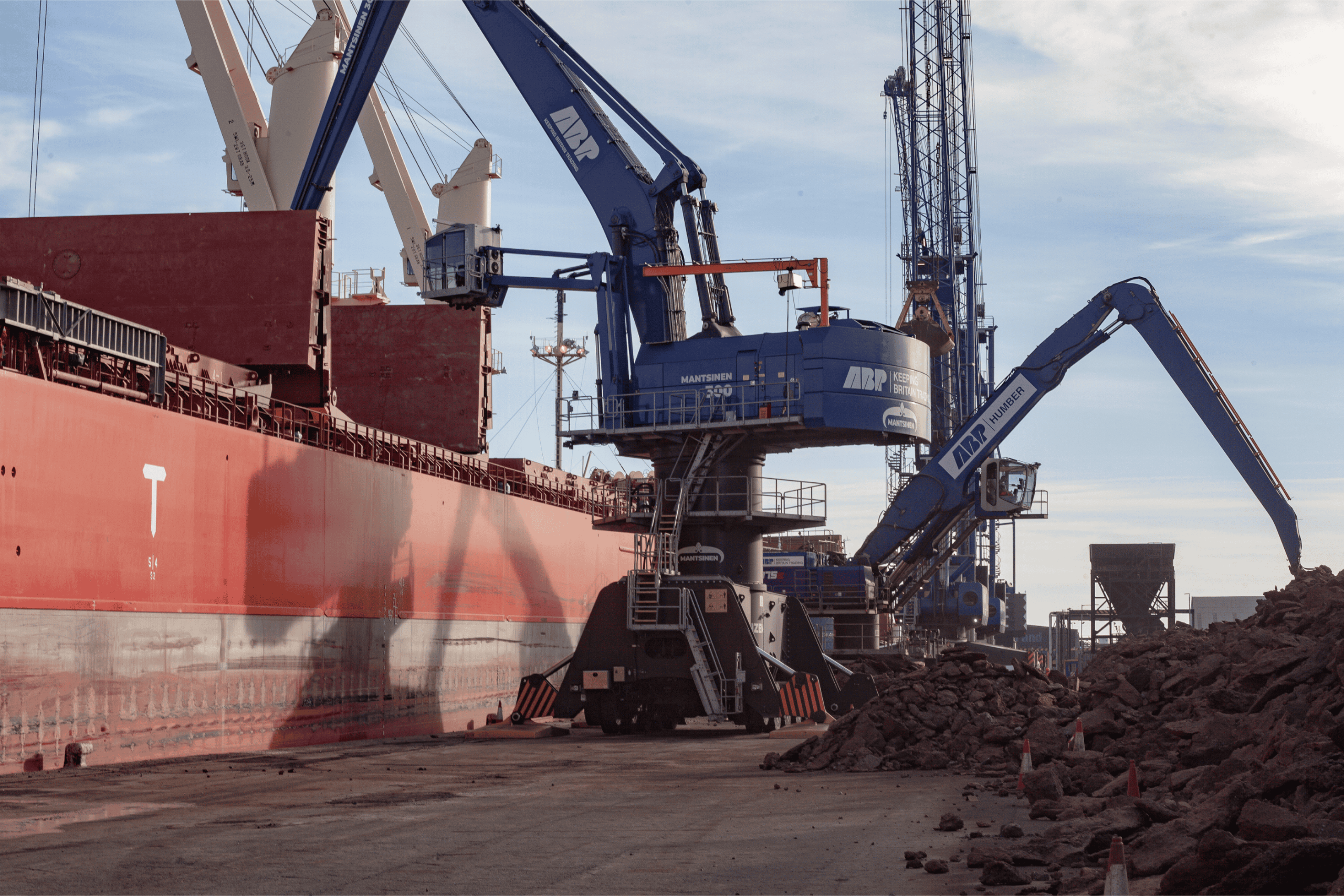
Vertical integration can result in measurable carbon savings. Some vertical integrators have developed port‑side facilities that reduce the number of transportation movements, optimise route efficiency and enable direct vessel loading with less handling.
For example, European Metal Recycling (EMR) invested a multi‑million‑pound sum to develop a new deep‑sea dock at the Port of Glasgow. According to EMR, the large bulk carriers used at this dock generate only around one‑fifth of the CO₂ per tonne of materials transported compared to smaller coastal vessels, while also removing the need for multiple inland transfer stages[10]. By eliminating inland transfers, EMR has reduced both emissions and operating costs.
Fewer steps mean fewer emissions – and this also delivers better economics through lower fuel, handling and administration costs across the chain.
Carbon accountability through corporate procurement
Over 10,000 global companies have set Science Based Targets[11] by 2026, and many OEMs and Tier 1 manufacturers now ask for emissions information from suppliers as part of their standard procurement process. Suppliers who do not have documentation of their emissions may lose competitive advantage in competitive tenders, particularly where carbon intensity is scored alongside price and quality.
From 30 September 2021, all in‑scope UK central government procurement contracts above £5 million are subject to PPN 06/21[12] which requires bidders to submit a compliant Carbon Reduction Plan. Increasingly, companies are asking for emissions data in their Request for Quotation (RFQ) documents and incorporating carbon metrics into their bid evaluation processes.
Port Talbot and the UK EAF transition
The £1.25 billion electric arc furnace (EAF) project at Port Talbot by Tata Steel UK[13], once complete, is backed by a joint UK Government and Tata Steel investment package and is a cornerstone of the UK’s “green steel” transition. The new EAF facility is expected to use large volumes of UK scrap steel and significantly reduce the Port Talbot site’s direct CO₂ emissions – Tata Steel indicates a potential reduction of up to 5 million tonnes of CO₂ per year compared with the current blast furnace–basic oxygen furnace (BF‑BOF) route.
Typical global averages indicate that BF‑BOF steel production generates approximately 2.3 tonnes of CO₂ per tonne of crude steel produced, whereas EAF steel production using scrap generates around 0.7 tonnes of CO₂ per tonne[14]. Therefore, average emissions from EAF production are roughly 70% lower than those generated from BF‑BOF steelmaking.
Operational and economic alignment
By integrating collection, processing and exportation, there will be fewer road miles travelled and therefore fewer emissions and lower costs. Fewer intermediaries mean fewer movements of goods, lower cumulative handling, simpler scheduling and reduced administrative overhead.
Freight costs are also reduced when scrap flows directly to port‑side facilities and is loaded onto larger, more efficient vessels, especially when compared to chains that rely on multiple HGV legs and smaller ships. For companies who are being forced to increase their Scope 3 reporting – and who may be subject to additional annual costs under mechanisms such as the EU Carbon Border Adjustment Mechanism (CBAM)[15] – using a low‑carbon‑footprint supply chain is commercially beneficial.
Practical implementation
According to the British Metals Recycling Association (BMRA) Carbon Footprint Assessment[16], most of the emissions generated by the UK metals recycling industry come from third‑party transport and downstream processing. With UK steel production moving towards utilising EAF technology and Scope 3 reporting expected to become compulsory for more companies, industry participants that remove unnecessary intermediaries stand to benefit from a lower carbon footprint, lower costs and stronger ESG credentials.
Enicor operates from two UK sites: Enicor’s collection and processing facility in Bourne, Lincolnshire, and Enicor’s export operations at the Port of Immingham. We collect, process and export customers’ metals under one integrated operational framework.
Our quayside facilities at the Port of Immingham enable us to load vessels directly, which can reduce emissions when compared to multi‑legged road transfer chains followed by export via smaller ports.
To find out more please visit enicor.co.uk or follow us on LinkedIn.
References
[1] Normative. (2025, March 2). Scope 1, 2, and 3 emissions, explained. https://normative.io/insight/scope-1-2-3-emissions-explained/
[2] World Resources Institute & World Business Council for Sustainable Development. (n.d.). The Greenhouse Gas Protocol: A Corporate Accounting and Reporting Standard. https://ghgprotocol.org/
[3] National Grid. (n.d.). What are scope 1, 2 and 3 carbon emissions? https://www.nationalgrid.com/stories/energy-explained/what-are-scope-1-2-3-carbon-emissions
[4] British Metals Recycling Association. (2025, December). Carbon Footprint Assessment. https://www.recyclemetals.org/asset/DC50DF63-761C-48E4-90B77A64AB1BADD7/
[5] UK Government. (n.d.). Streamlined Energy and Carbon Reporting. https://www.gov.uk/guidance/streamlined-energy-and-carbon-reporting
[6] Task Force on Climate-related Financial Disclosures. (n.d.). TCFD Recommendations. https://www.fsb-tcfd.org/
[7] Let’s Recycle. (2026, February 4). UK metals recycling emissions could fall 93% by 2050. https://www.letsrecycle.com/news/uk-metals-recycling-emissions-could-fall-93-by-2050/
[8] Circularise. (2026, January 11). Scope 1, 2, 3 emissions explained. https://www.circularise.com/blogs/scope-1-2-3-emissions-explained
[9] UK Government. (n.d.). Government conversion factors for company reporting. https://www.gov.uk/government/collections/government-conversion-factors-for-company-reporting
[10] Circular Online. (2026, February 4). UK metals recycling’s operational emissions could fall 93% by 2050. https://www.circularonline.co.uk/news/uk-metals-recyclings-operational-emissions-could-fall-93-by-2050/
[11] Science Based Targets Initiative. (n.d.). Companies taking action. https://sciencebasedtargets.org/companies-taking-action
[12] UK Government. (2021, September 30). Procurement Policy Note 06/21: Taking account of Carbon Reduction Plans in the procurement of major government contracts. https://www.gov.uk/government/publications/procurement-policy-note-0621-taking-account-of-carbon-reduction-plans-in-the-procurement-of-major-government-contracts
[13] Tata Steel UK. (2026, March 16). Green Steel Future. https://www.tatasteeluk.com/green-steel-future
[14] Data Insights Market. (2025, July 14). Tata Steel’s Green Steel Revolution: £1.25B EAF in Port Talbot. https://www.datainsightsmarket.com/news/article/tata-steels-green-steel-revolution-125b-eaf-in-port-talbot-77864
[15] European Commission. (n.d.). Carbon Border Adjustment Mechanism. https://taxation-customs.ec.europa.eu/carbon-border-adjustment-mechanism_en
[16] British Metals Recycling Association. (2025, December). Carbon Footprint Assessment. https://www.recyclemetals.org/asset/DC50DF63-761C-48E4-90B77A64AB1BADD7/